Here is a readable, chapter-by-chapter breakdown of the video transcript about AI in the workplace.
Chapters
- 0:00 – 0:38 | Introduction: The Big Questions
- AI will reshape workplaces, raising concerns about job security for current and future generations.
- Host Isabel Berwick (FT’s Working It podcast) explores how leaders can make work better.
- 0:51 – 1:41 | What is Generative AI?
- Generative AI emerged over the last three years, translating text, images, video, and code.
- The big turning point was the launch of ChatGPT in late 2022, allowing anyone to interact directly with the system.
- 1:44 – 2:32 | The CEO Dilemma: Ferraris Without Driving Lessons
- Businesses are pushing to harness AI, but leaders have bought « Ferraris » (AI systems) without giving staff « driving lessons. »
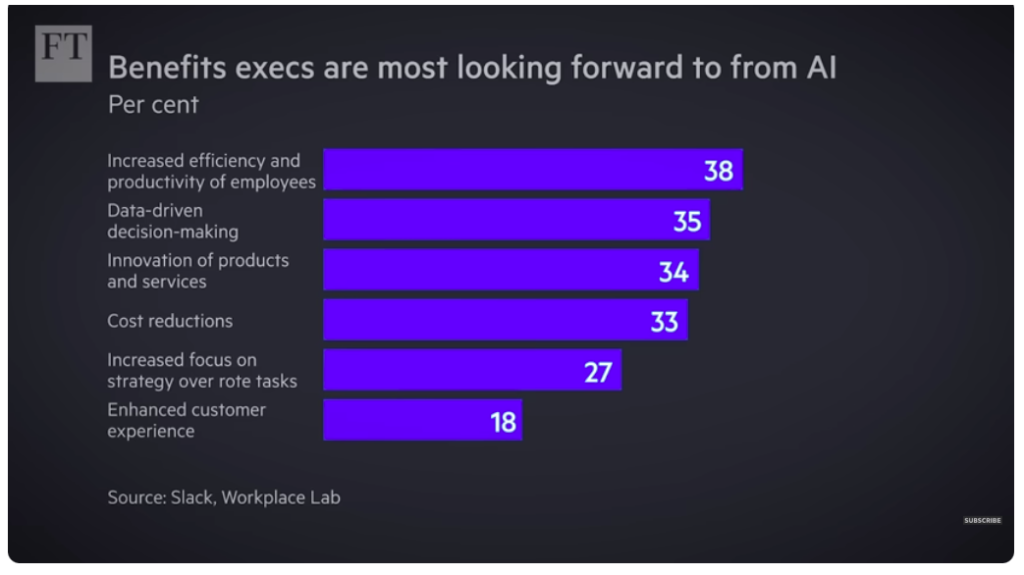
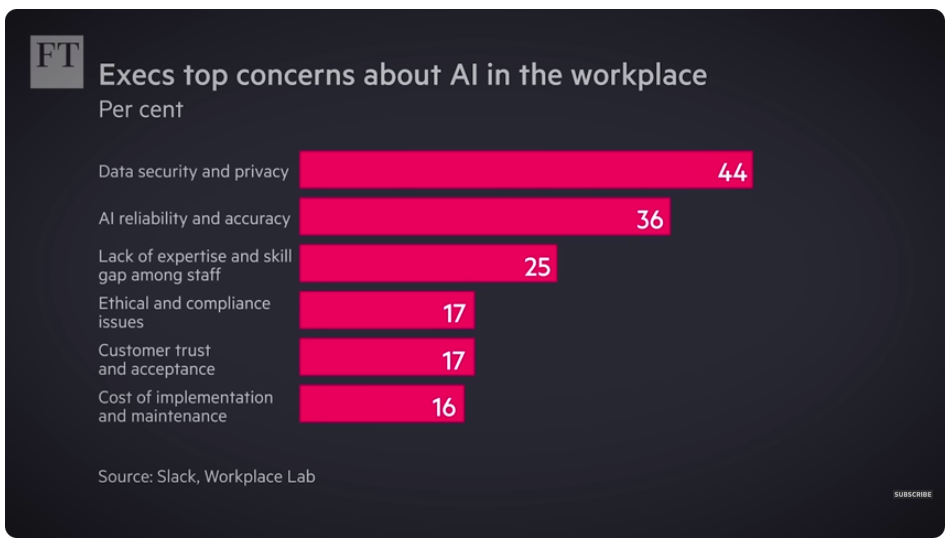
- Executives want increased productivity, but worry about data security, privacy, and AI’s accuracy.
- 2:32 – 4:35 | The 5 AI Personas (Slack’s Workforce Lab)
- There is a disconnect: executive urgency is high, but two-thirds of desk workers don’t use AI.
- Christina Janzer (Slack) identified five personas:
- Maximalist: Excited and active user.
- Underground: Active user, but hides it due to guilt/feeling of cheating.
- Rebel: Sees AI as a threat.
- Superfan: Excited, but doesn’t know how to start.
- Observer: Wait-and-see mentality.
- 4:41 – 6:27 | The Trust & Manager Factor
- Only 7% of workers fully trust AI.
- People who feel trusted by their manager are twice as likely to try AI.
- Cool technology doesn’t matter if people won’t use it.
- 6:40 – 7:16 | The Solution: Guidelines & Transparency
- Businesses need clear policies. When companies cater to all personas and have safe usage guidelines, employees are 6x more likely to use AI.
- Currently, 43% of desk workers have received no guidance on using AI at work.
- 7:47 – 9:52 | How Experts Use AI (Azeem Azhar)
- Tech investor Azeem Azhar uses AI assistants to transcribe meetings and even evaluate his performance.
- Downsides: AI can be complicated and unreliable.
- Warning: Leaders should be careful about using AI for cost-cutting (headcount reductions) in an unstable environment.
- 9:54 – 11:55 | AI as a Skills Equalizer & HR Demo (Lattice)
- Senior execs do better with AI because they know how to delegate tasks.
- Lattice (HR software) uses AI to create performance reviews. It helps « save bad managers from themselves » by making feedback inclusive, actionable, and concise.
- 12:00 – 13:28 | Will AI Finally Simplify Work?
- Past tech advances made us work harder. AI promises to simplify things by bringing data together behind the scenes.
- The main use case currently is making work life easier by answering questions and providing guidance.
- 13:30 – 14:29 | The Next Wave: AI Agents & The Trust Question
- Next year: AI agents that don’t just tell you what to do, but perform actions for you.
- Leaders must build trust through communication and education.
- 14:32 – 15:33 | Is AI Moving Too Fast?
- Leaders shouldn’t panic-pause, but they need to get their data in order and help people understand what’s happening.
- The biggest workplace shift in our lifetimes requires trial and error.
- 15:34 – 16:51 | Conclusion: Scepticism is Healthy
- AI is expensive to build. Companies are not passing on costs yet (they want adoption first).
- Key advice: Don’t go « all in » on hype. Take a step back and think about where AI truly makes a difference.
- The tech is imperfect, and we aren’t patient with mistakes. It’s right to be a bit sceptical.
This was December 2, 2024 YouTube video from Financial Times. Do you think something has changed since then?Excellent question. We are roughly 18 months after the video was published (Dec 2024) and about 6 months beyond when the question was first asked. The short answer is: Yes, dramatically.
The period you’re asking about (late 2025 through mid-2026) is precisely when the market shifted from « talking about Ferraris » to « building the roads. » We have moved from the Hype Cycle’s peak into the messy, chaotic « Trough of Disillusionment »—but also into the beginning of real, measurable deployment .
Here is the scorecard of what has changed since that FT video aired, broken down by the themes they discussed.
1. The « Adoption Gap » Has Narrowed (But Not How They Expected)
- The Video’s Claim (Dec 2024): Two-thirds of desk workers were not using AI. There was a massive disconnect between executive urgency and employee action.
- What Happened Next (2025-2026): Usage exploded, but largely because AI stopped being a « tool you go to » and became a feature built into tools you already use.
- The Shift to « Passive » AI: The FT video focused on ChatGPT. By mid-2025, « passive » AI (Google Search summaries, AI in Microsoft/Google Workspace) overtook standalone apps. By mid-2026, Deloitte predicts 72% of adults will have used AI search summaries vs. 61% for standalone tools .
- SMB Catch-up: In late 2024, only 31% of small businesses used AI. By early 2026, that jumped to 55% .
2. The « Agentic » Shift (From Chat to Action)
- The Video’s Claim: AI would « tell you what to do. »
- What Happened Next: The market pivoted to AI Agents—software that doesn’t just write emails, but negotiates contracts or matches invoices.
- Enterprise Reality: By late 2025, 45% of Canadian enterprises had deployed agents in production. Companies expect to double the number of agents by the end of 2026 .
- Vendor Lock-in: Oracle announced it has added 600+ AI agents to its suite (HR, Supply Chain) in just one year, with plans for hundreds more in 2026 .
3. The « Trust Gap » Has Become a Crisis
- The Video’s Claim: Trust was missing (only 7% fully trusted AI).
- What Happened Next: The gap didn’t close; it turned into outright workplace friction.
- The Chasm: A mid-2026 study shows only 9% of workers trust AI for complex decisions, compared to 61% of executives. That is a 52-point gap .
- The « Workslop » Problem: Workers are rebelling. 54% admit to bypassing AI tools to do tasks manually because the AI output is poor quality . 53% of workers have submitted « workslop » (AI content that looks good but is useless), which actually increases the burden on colleagues .
- Shadow AI: 45% of workers use unauthorized AI tools with company data because they don’t trust or know the official policy .
4. The « Lattice » Scenario (HR Tech) Has Arrived
- The Video’s Claim: HR software (Lattice) was helping bad managers write better reviews.
- What Happened Next: HR AI has become the standard for « internal mobility. »
- Case Study Example: Delta Air Lines uses AI to map skills. After implementation, 25% of management positions were filled with existing frontline staff .
- ROI Reality Check: Despite the hype, only 10.4% of enterprises are seeing measurable results from most of their AI projects .
5. The Bottom Line: The « Hope » Strategy Failed
In the video, the Lattice CEO said, « Hope can’t be our strategy. » In 2026, companies are learning that lesson the hard way.
- Abandonment is up: 42% of companies are abandoning AI initiatives (up from 17% the previous year) .
- Financial reality: The free ride is ending. Building these models costs tens of billions. The moment you see real value, vendors will start charging for it aggressively.
Summary Verdict
If the FT video in Dec 2024 was about excitement and confusion, the reality of June 2026 is about friction and pragmatism.
- The Good News: AI is now embedded everywhere. You don’t have to « try » to use it anymore; it is just in your Google search, your Word doc, and your HR portal.
- The Bad News: The « Underground » persona from the video has won. Workers are hiding their usage, fighting against « workslop, » and trust between CEOs and employees is at an all-time low.
We are no longer asking « Should we buy the Ferrari? » We are asking « Who crashed the Ferrari into the wall, and why are we still paying for gas? »
